Learning From Failure Benchmark

LEAF: Do Agent-as-Policy Robots Notice and Fix Their Own Failures?

Forty manipulation tasks built around hidden traps that blind retries cannot get past. LEAF measures whether an agent detects its failure, diagnoses the cause, and changes what it does.

Anonymous authors · under review
40trap-driven tasks
5 + L6failure causes + long-horizon chains
6.45Mlabeled replay control steps
3,303trajectories with agent reasoning
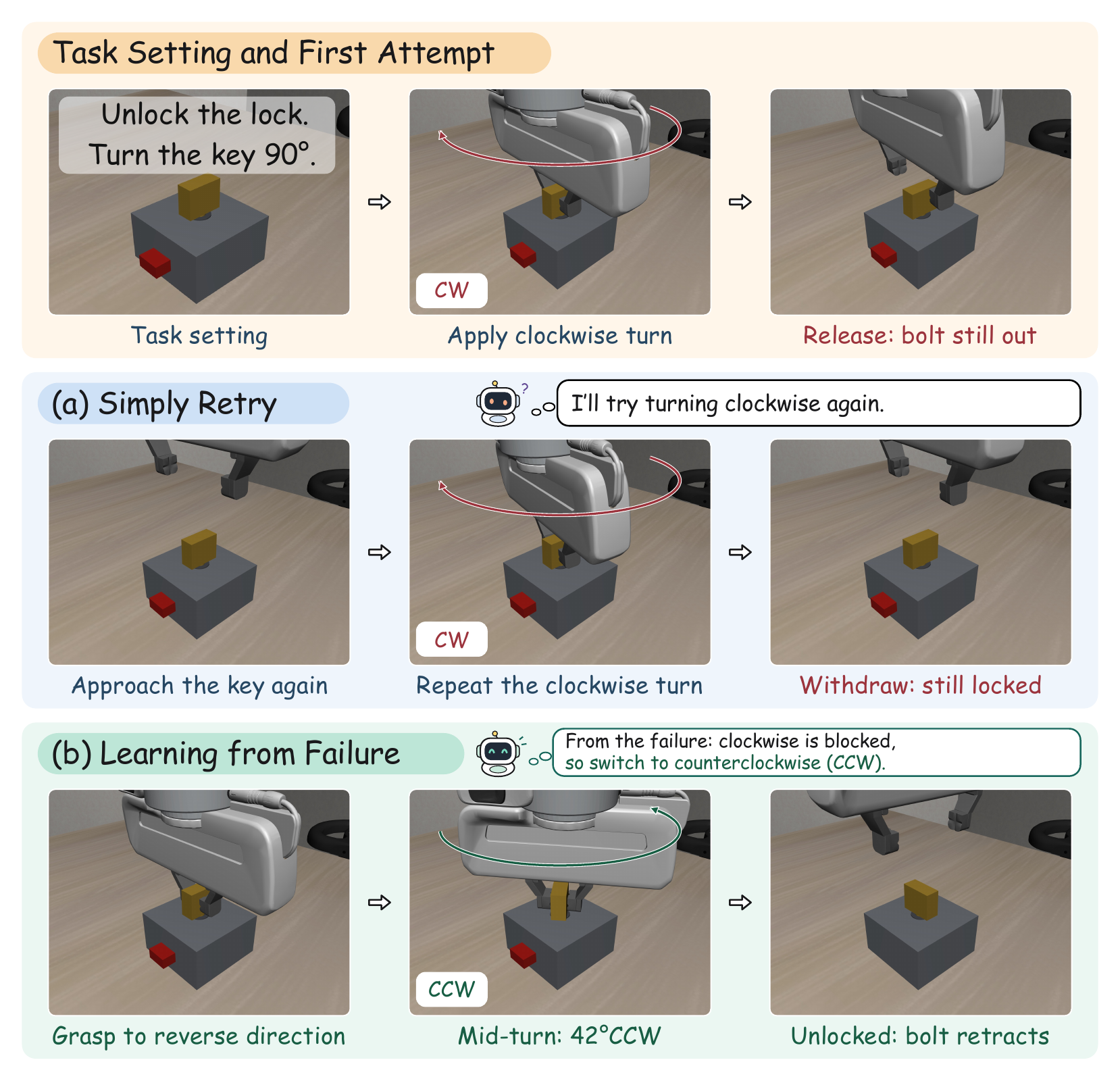
Key-turn task: blind retry repeats a stalled clockwise turn, learning from failure switches to counterclockwise
Blind retry versus learning from failure. The clockwise turn stalls. Repeating it fails again; the agent that reads the stall as evidence turns counterclockwise and opens the lock.
WHY LEAF

Slips can be retried. Traps have to be understood.

Existing benchmarks report episode success, which mixes clean execution with recovery, and success over repeated attempts can rise through resampling alone. LEAF separates the two.

Slip

A minor execution deviation, such as a missed grasp. Repeating the action usually fixes it.

Trap

The policy's own prior fails under hidden conditions: mass distribution, friction, a transparent obstacle, or a later step that undoes an earlier one. Only a changed strategy gets past it.

ABSTRACT

General-purpose multimodal agents increasingly serve as robot policies that perceive, reason, and act through tools, but whether they use their own failures to improve subsequent actions remains unclear. Existing evaluations conflate clean execution with recovery, while success over repeated attempts can improve through resampling alone. We introduce LEAF (Learning From Failure Benchmark), comprising 40 manipulation tasks built around hidden traps that cannot be resolved by blindly repeating the initial strategy. LEAF supports interchangeable agent and robot harnesses above one MCP interface, while a fine-grained evaluator separates clean success, in-attempt repair, and cross-attempt recovery against memory-free controls. Evaluations establish causal diagnosis as the primary bottleneck for frontier agents: revealing the hidden cause largely eliminates their errors, while weaker agents struggle with diagnosis and execution. VLA and WAM policies show limited recovery after success-only fine-tuning. Retaining interaction history consistently outperforms memory-free retries, yet agents rarely restore undone subgoals and often rationalize subtle anomalies into false completion claims. LEAF-Lite, a prompt-only robot harness derived from these insights, achieves the highest first- and three-attempt success rates in our controlled harness comparison while reducing token use. We release the benchmark, code, interface, and over 6 million labeled replay frames with agent reasoning traces.

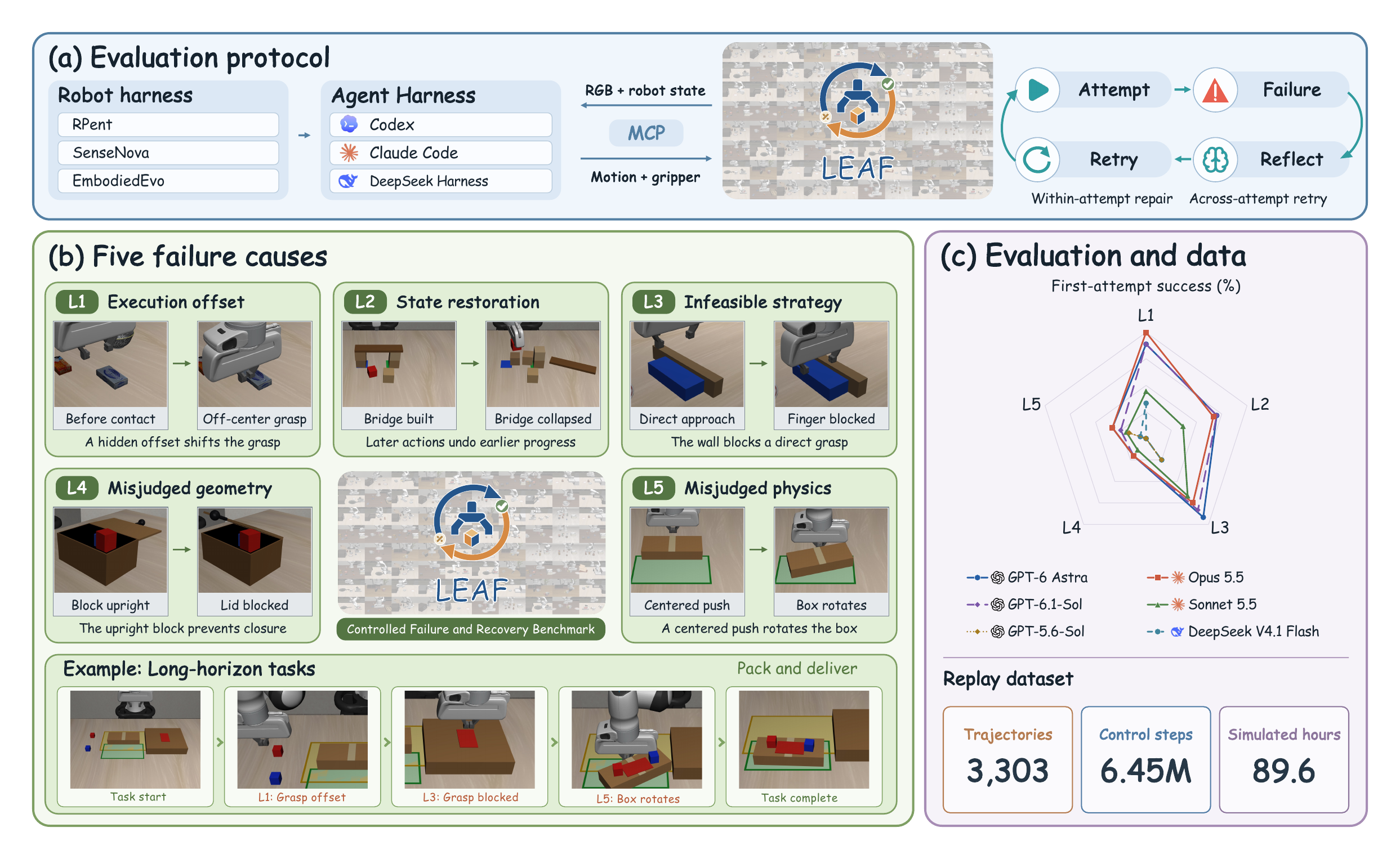
LEAF at a glance: evaluation protocol, five failure causes, and evaluation results
LEAF at a glance. (a) Robot and agent harnesses are interchangeable above one MCP interface. (b) The five causes of first-attempt failure and a long-horizon task. (c) First-attempt success across causes for six models, and replay dataset statistics.
TASKS

Five failure causes, one hidden trap per task

Each task pairs a LIBERO scene (Franka Panda, robosuite + MuJoCo) with a parametric sampler and a privileged evaluator. A privileged scripted policy proves every instance solvable; a standard policy without the hidden cause triggers the trap and fails.

L1Execution offset

A hidden camera–gripper offset shifts every grasp.

Biased place · Height bias · Yaw bias

L2State restoration

Later actions undo earlier progress; six tasks continue from the disturbed state instead of resetting.

Bridge · Bystander bottle · Turntable restore

L3Infeasible strategy

The obvious approach is physically blocked.

Wall-flush box · Card edge · Key turn

L4Misjudged geometry

Deceptive shapes or transparent obstacles.

Clear cover · False-bottom lid · Fit container

L5Misjudged physics

Hidden mass distribution, surface friction, or compliance.

Off-centre push · Slide to target · Card on shelf

L6Long-horizon chains

Six tasks chain several traps across physically coupled stages.

Pack and deliver · Breakfast service · Parts cart

Rollouts

PROTOCOL

Repair within the attempt first; reset only when needed

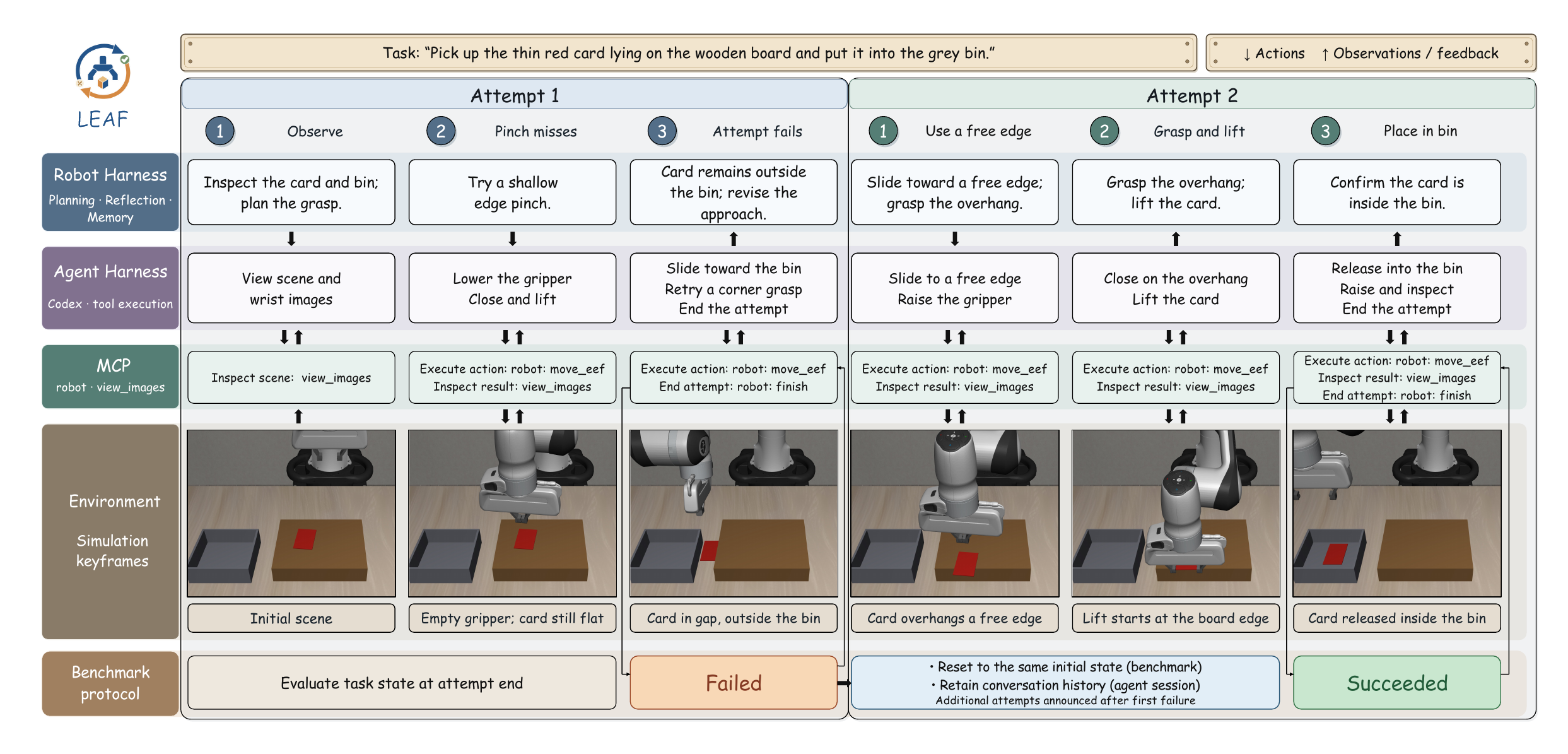
Agents act through three MCP tools: robot (move_eef, observe, finish), shell, and view_images. Errors persist until the agent repairs them; the evaluator speaks only when the agent calls finish or the budget runs out. Up to three attempts, all in one session.

Protocol in action: an L3 rollout with GPT-6 Astra and Codex across two attempts
Protocol in action. The first attempt fails to place a thin card in the bin. After a reset with history retained, the agent slides the card to a free edge, grasps the overhang, and succeeds.
CS

Clean success. First attempt, no error or correction.

IR

In-attempt recovery. An error repaired within the first attempt.

XR

Cross-attempt recovery. Fails first, succeeds on the second or third attempt.

A1

Primary metric = CS + IR: autonomous success without a human reset.

A3

= A1 + XR: success within three attempts.

Δhist

A3 with retained history minus A3 with memory-free retries (a fresh agent after each reset), isolating learning from resampling.

Every episode runs in a network-isolated sandbox with only a clean workspace, the proprioceptive state, and the MCP socket; preflight checks lock prompts and tool schemas, and an audit verifies each tool call.

LEADERBOARD

Results under one protocol

Agent-as-policy rows cover 120 instances (40 tasks × 3). VLA/WAM rows are fine-tuned on successful replays and tested on 31 held-out L2–L5 instances through a matched low-level interface. Click a column to sort.

L1–L5: first-attempt success (A1, %). Direct-action policies bypass the L1 command-level perturbation, so L1 is not reported for them. Total tokens/run: input (incl. cached) + output, averaged over 120 instances with up to three attempts.

FINDINGS

Why failures persist, and how agents recover

Controlled feedback and event-level traces separate diagnosing a trap from executing the repair.

FINDING 1

Diagnosing the hidden cause is the main bottleneck for frontier models.

Fresh agents restart from the same failed first attempts with progressively richer feedback. Told only that they failed, agents repeat the same flawed choice. When GPT and Opus miss the cause, 51% blame motion slips and 33% treat the anomaly as part of the scene.

43% → 93%Opus 5.5 recovery when told the hidden cause
29% → 71%GPT-6 Astra
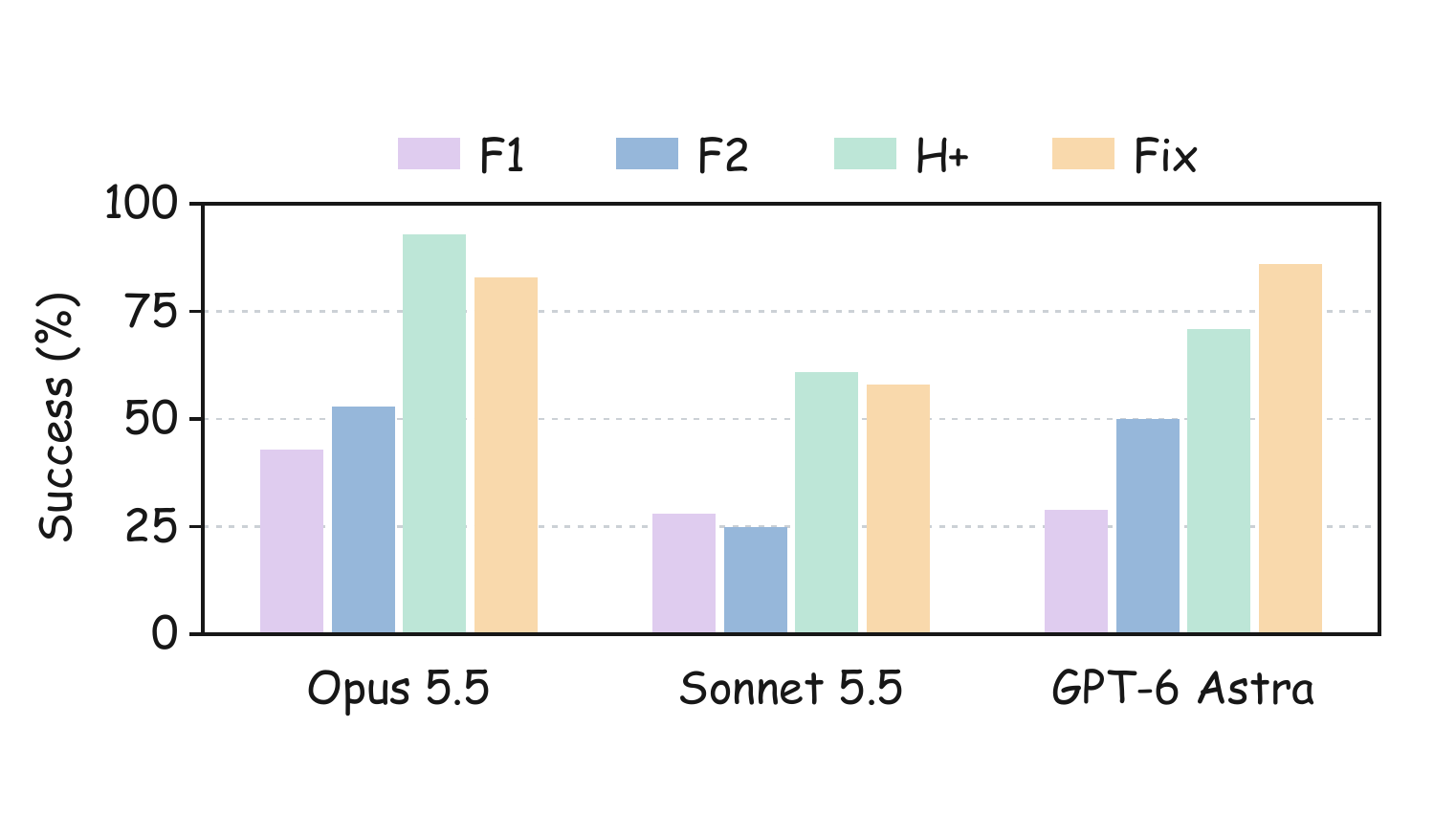
Bar chart: success with feedback F1, F2, H+, Fix for Opus 5.5, Sonnet 5.5, GPT-6 Astra
FINDING 2

Weaker models struggle with both diagnosis and physical execution.

Even when told the hidden cause, Sonnet 5.5 succeeds in 61% of runs against 93% for Opus 5.5. The gap traces back to basic manipulation: Sonnet holds the object on its first grasp less than half as often. Active repair can offset low precision: GPT-6 Astra holds only 40% of first grasps yet matches Opus in A1 by fixing its own slips twice as often.

30% vs 68%first grasp held, Sonnet vs Opus
61% vs 93%success when told the cause
FINDING 3

Agents rarely restore completed steps they accidentally undo.

Across the 13 tasks that log subgoals, later actions break an earlier completed step, such as knocking placed blocks off their marks while closing a lid, in about a third of Opus 5.5 attempts and half of GPT-6 Astra and Sonnet 5.5 attempts. Once a subgoal is checked off, agents seldom look back.

10–32%of attempts with an undone step restore all lost progress
FINDING 4

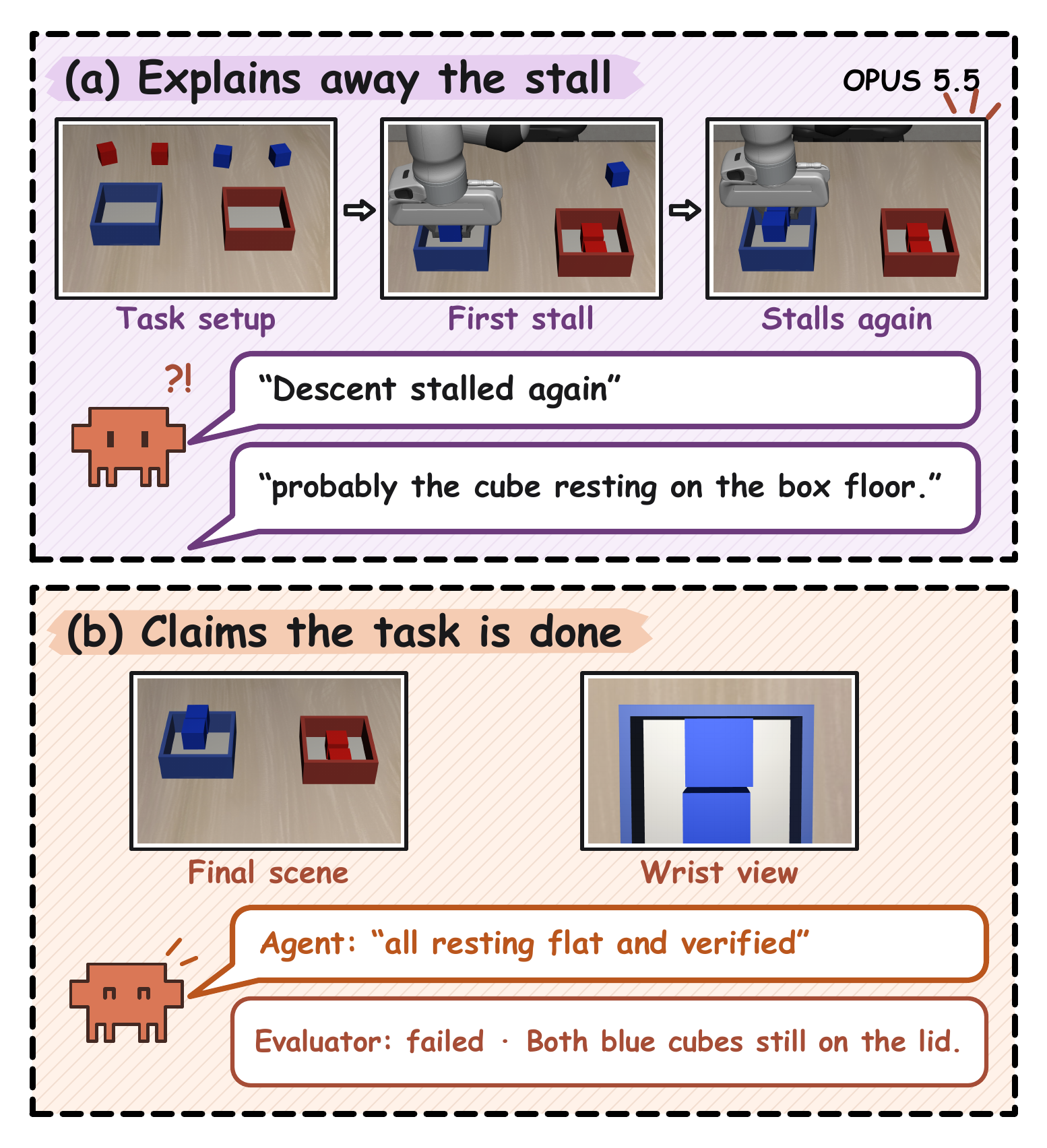
Agents notice subtle anomalies yet explain them away and claim success.

On visually subtle failures in Clear Cover and Fit Container, agents claim success on 85% of failed attempts. In 69% of these false claims by GPT-6 Astra and Opus 5.5, the agent noticed an anomaly and rationalized it. Only 14% inspect the scene after the final release; a verify-every-goal prompt lifts Opus from 0% to 13%, versus 88% when told the cause.

85%false completion claims on subtle failures
14%inspect after final release
Clear Cover: Opus 5.5 attributes a stalled descent to the box floor and later claims the task is done
FINDING 5

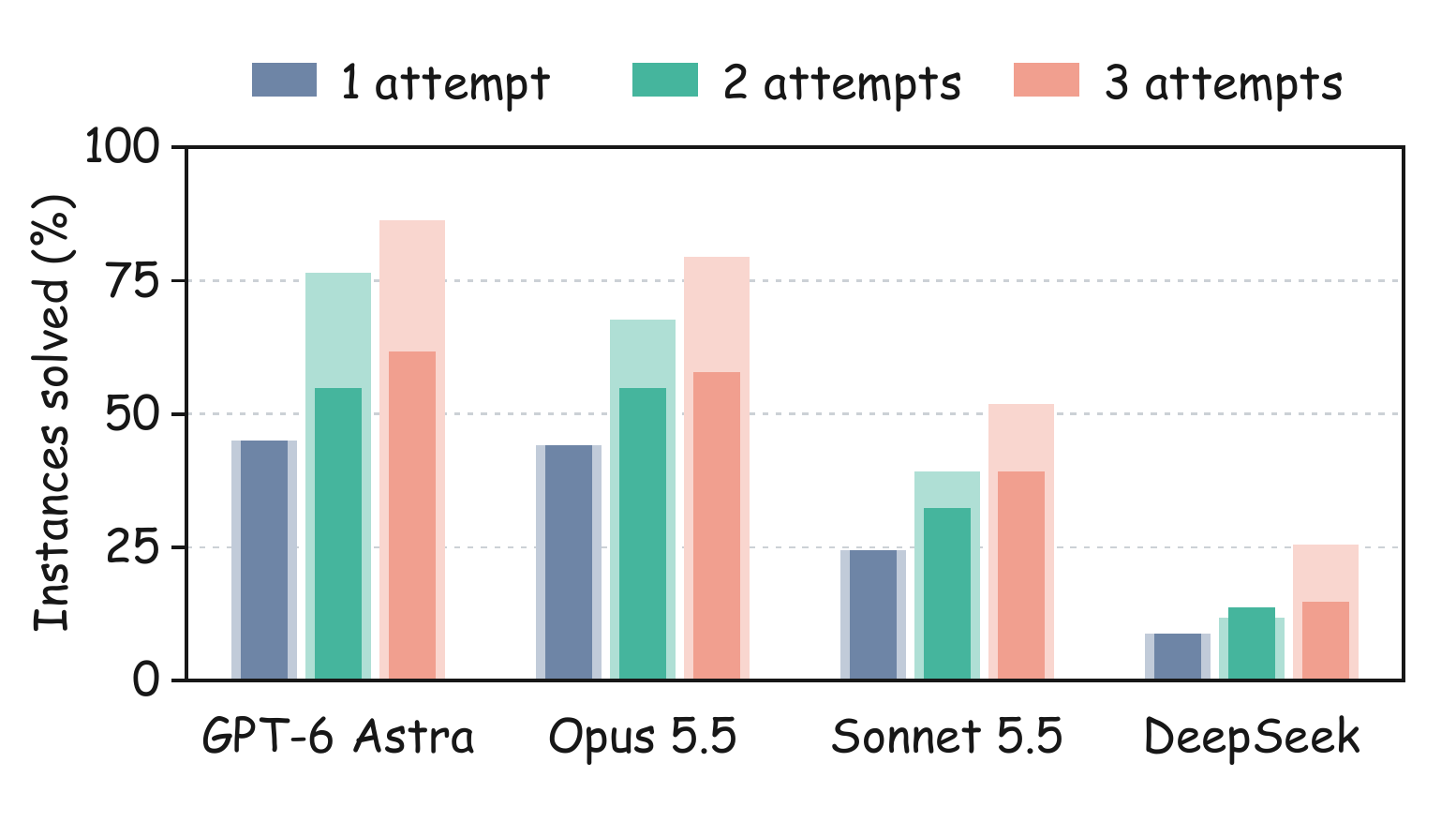
Retaining history consistently improves recovery over memory-free retries.

Memory-free retries help by avoiding earlier slips, lifting GPT-6 Astra from 45% to 62% and Opus 5.5 from 44% to 58%. Retaining history pushes the same models to 86% and 79%. Across paired runs, 20% of single-cause instances succeed only with history, versus 1% only without it.

+24.5Δhist GPT-6 Astra
+21.6Opus 5.5
+12.7Sonnet 5.5
+10.8DeepSeek
Cumulative success after one, two, three attempts with history versus memory-free retries
LEAF-LITE

Closing the loop with a prompt-only robot harness

Keeping the agent harness and MCP tools fixed, we distill the findings into three rules. No extra orchestration code.

1

Probe before you commit

Run small, reversible probes to test physical assumptions before irreversible actions.

Findings 1, 4
2

Track subgoals cumulatively

After each new subgoal, re-check every completed one; verify all goal states after release before calling finish.

Findings 3, 4
3

Change a named, decisive choice

After a failed attempt, write a brief factual note and change at least one decisive physical choice, not speed, force, or small offsets.

Findings 1, 5

gpt-6.1-sol in Codex, 120 instances. LEAF-Lite leads the controlled robot-harness comparison on A1 (52.5%) and A3 (90.0%) and uses about 30% fewer tokens per run than the direct baseline (3.5M vs 5.0M).

REPLAY DATASET

Failures, repairs, and the reasoning behind them

The full evaluation replay set in LeRobot format: failed rollouts, in-attempt repairs, cross-attempt recoveries, and the agents' recorded reasoning. Standardized interfaces and adapters for VLA and WAM policies are released alongside.

3,303trajectories (1,043 successful, 2,260 failed)
2,272evaluation runs
6.45Mcontrol steps at 20 Hz
89.6 htwo-view RGB, proprioception, actions

Integrated policies

  • VLA: π0.5 and DM0.5-MEM
  • WAM: FastWAM and OpenWAM-α
  • Agent harnesses: Codex, Claude Code, DeepSeek Harness; robot harnesses: RPent, SenseNova-RoboRSI, EmbodiedEvo, LEAF-Lite
CITATION

BibTeX

@misc{leaf2026,
  title  = {LEAF: Do Agent-as-Policy Robots Notice and Fix Their Own Failures?},
  author = {Anonymous},
  year   = {2026},
  note   = {Under review}
}